Countries Visited Tracker: A Record Worth Returning To
Build a countries visited tracker with a simple list, map or journal. Reconstruct old trips, decide what counts, and keep the memories behind each place.

To track the countries you've visited, start with a country list and a separate entry for each visit. Record the place, a date or approximate year, and one detail you want to remember. You can do this in a notebook, spreadsheet or app, then turn the list into a visited countries map.
The list can be surprisingly easy to begin. The difficult part is the year. Was that first trip to Portugal before the move, or after? Which summer was the overnight train? Travel leaves plenty of evidence, but rarely in one place.
A good countries visited tracker brings those fragments together. It gives you an answer when someone asks where you've been. More usefully, it gives you somewhere to return to when the answer needs more than a number.
Choose a record you will actually update
A plain list is enough if you want to remember which countries you've visited. Put it in a note you already use. Add a place when you return, and keep an extra section for entries you still need to check. There is no need to build a complicated system before recording the first trip.
A spreadsheet is useful when the questions get more specific: which year, how many returns, which places on the same journey? It lets you sort your history without rewriting it. Keep one sheet for individual visits and another for your distinct country list, so repeat trips don't inflate the total.
A map makes the geography visible. It can remind you of a neighboring country you've forgotten or show how a long trip fitted together. Its limitation is scale: a weekend in one city can color an entire country. Use it as an overview, with the details kept elsewhere.
A journal makes room for the things a map cannot show. You might remember a morning market, a friend who met you at the station, or the book you read on the ferry. A few lines beside a date can be more useful than a lengthy entry you never finish.
An app can bring several of these approaches together. If you prefer that route, our guide to choosing a country counter app looks at the features worth checking before entering years of travel.
Choose the format that fits your existing habits. A beautiful blank journal and an abandoned spreadsheet have the same country count.
Build your first travel record in one sitting
Open a blank note or spreadsheet and give it these five fields. The entries below are examples, not a travel history to copy.
| Place | When | Visit type | Evidence or confidence | One memory |
|---|---|---|---|---|
| Portugal — Lisbon | September 2022 | First visit | Photo dates checked | Dinner with university friends |
| Portugal — Porto | Spring 2024, approximate | Return visit | Year certain; month uncertain | Rain on the riverfront |
| Qatar — Doha airport | 2024 | Airside transit | Flight itinerary | Connection only; excluded from count |
Begin with the trips you can name without looking anything up. Work through chapters of your life: childhood holidays, school or university, different homes, different jobs. This is often easier than moving alphabetically through a world checklist.
Give each visit its own row, even if the country is already there. For a journey through several countries, use a shared trip label, such as “rail trip, summer 2019,” to keep the entries connected. Then build your country list from the places you have decided to count.
Leave uncertain dates uncertain. “2016, probably autumn” is a useful record. A precise date chosen because a form demands one is a future misunderstanding. In a tool that requires an exact date, check its options before entering an estimate, and make the uncertainty clear in a note if you proceed.
Finally, add one memory to each visit. The aim of this first sitting is a workable beginning. You can investigate the gaps later.
Reconstruct the trips you've almost forgotten
Start with photographs. Look through older albums as well as your current phone: printed pictures, previous devices and family collections may cover different periods. Check dates and locations against what you remember rather than treating every label as definitive.
Next, search your email for a place name, airline, hotel or words such as “booking confirmation.” Calendar entries, ticket receipts and old itineraries can help establish the order. A reservation shows what you planned; pair it with another clue before assuming you actually traveled.
Ask the people who were there. A relative may remember the year through a birthday; a former traveling companion may still have the route. When two recollections conflict, keep a short note about the disagreement until another record settles it.
Old passports are useful clues too. Read the stamp dates alongside photographs and tickets. They won't necessarily contain every visit: the European Union's Entry/Exit System records border crossings electronically for travelers within its scope, without stamping their passports. The absence of ink is not a reason to remove a remembered journey from your personal record.
If your history spans several booklets, our guide to passport stamps after expiry and renewal explains what may happen to the originals and how to preserve them.
Decide what counts, and write the rule down
There is no single authority governing a personal travel list. The useful question is whether your rule makes the record clear to you and anyone you share it with.
Repeat visits: one country, several journeys
Count a country once in your distinct country total. Record each separate visit in your history. Three journeys to Japan can then appear as one country and three visits, with different dates and memories.
Define a visit consistently too. If one itinerary takes you into a country, across a border and back again, you might keep both stays under the same journey. You can retain the dates without pretending every border crossing was a separate holiday.
Layovers: keep transit visible
A practical rule is to exclude connections spent entirely inside an airport's transit area from your visited-country total. Log them as transit if they interest you. If you leave the airport and spend time in the destination, decide whether that meets your definition of a visit.
There is no need to invent a minimum number of nights. A short visit can be meaningful. Labeling transit separately keeps the record understandable without losing the route you traveled.
Territories and disputed places: retain the detail
Different checklists include different places. The UN currently has 193 member states and two non-member observer states, the Holy See and the State of Palestine. That is the basis for a common 195-entry benchmark; other travel lists include territories and additional destinations.
Keep the place you actually visited, even if your chosen country list doesn't give it a separate box. Use an additional destinations section for territories and places whose status your list handles differently. For disputed places, retain the local place name and note the classification you used. Your record needn't resolve a political disagreement to remember a journey accurately.
Changing borders: preserve the date and original description
If a place's name or borders have changed, record what it was called when you traveled and, where helpful, its present-day location. Don't automatically turn one historical visit into visits to every successor country. The actual route and date give you a better record than a revised total alone.
Make a visited-world map from your list
Once your list is reasonably settled, choose a map tool and check which destinations it includes. Mark the countries from your list, then compare its total with yours. Investigate differences before adding or removing entries: the tool may classify territories differently or include a transit you intended to exclude.
For a browser-based starting point, VisitedPlaces.com lets you select countries on a map or list, group them into steps, and download a PNG or HTML file. Its own instructions say the map is saved in its link, so keep that link if you want to return to it. Keep your written history too; an exported picture won't hold all the details in your visit log.
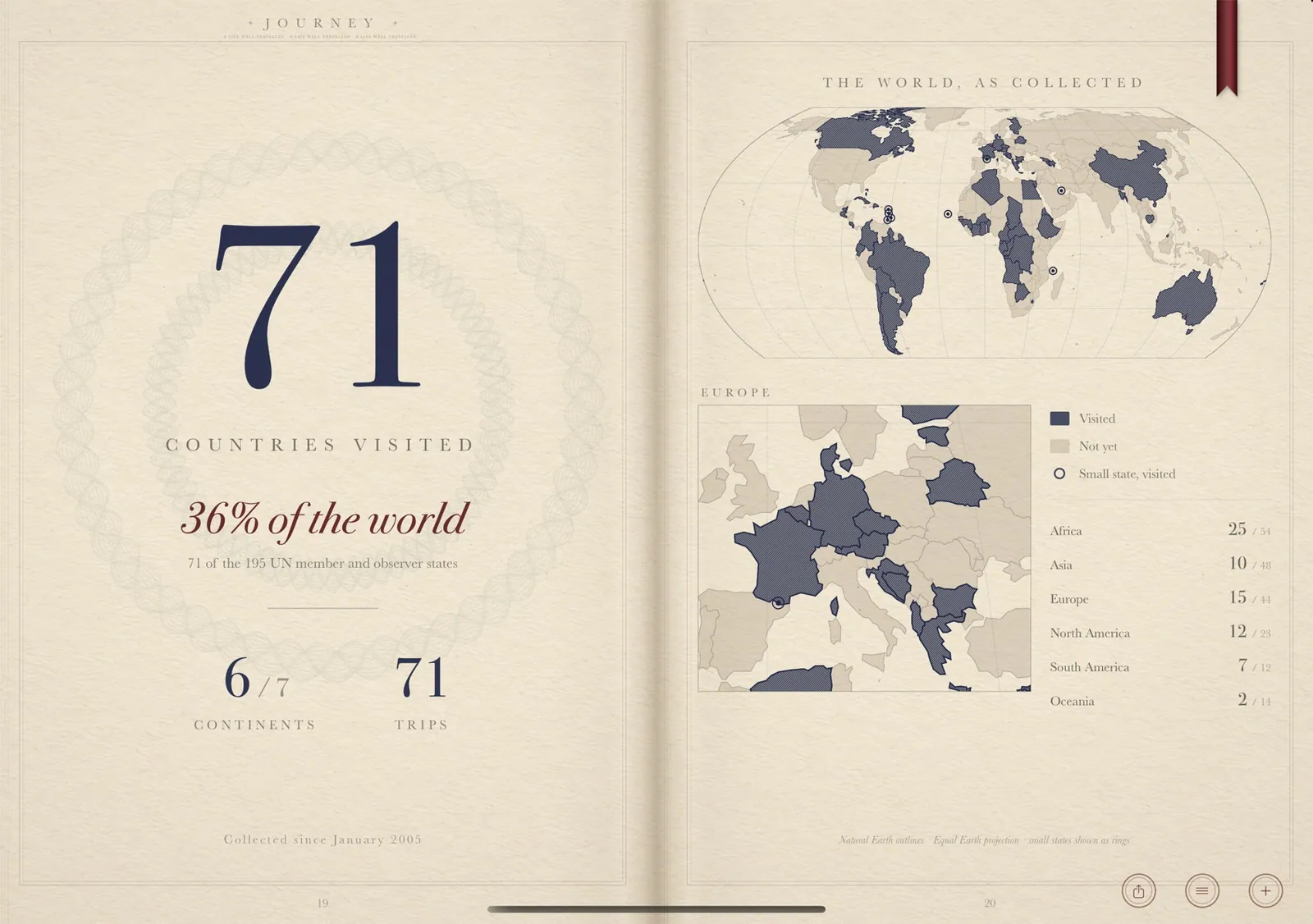
Remember what the shading means. You have visited those countries. It does not mean you have seen all of them.
Give the memories somewhere to live
A number can tell you how widely you've traveled. It cannot explain why you went back.
When you update your record, add one photograph and a sentence specific enough to bring the visit back: who was there, what surprised you, what you would otherwise forget. “Dinner with Maya after five years” will probably mean more later than “great food.”
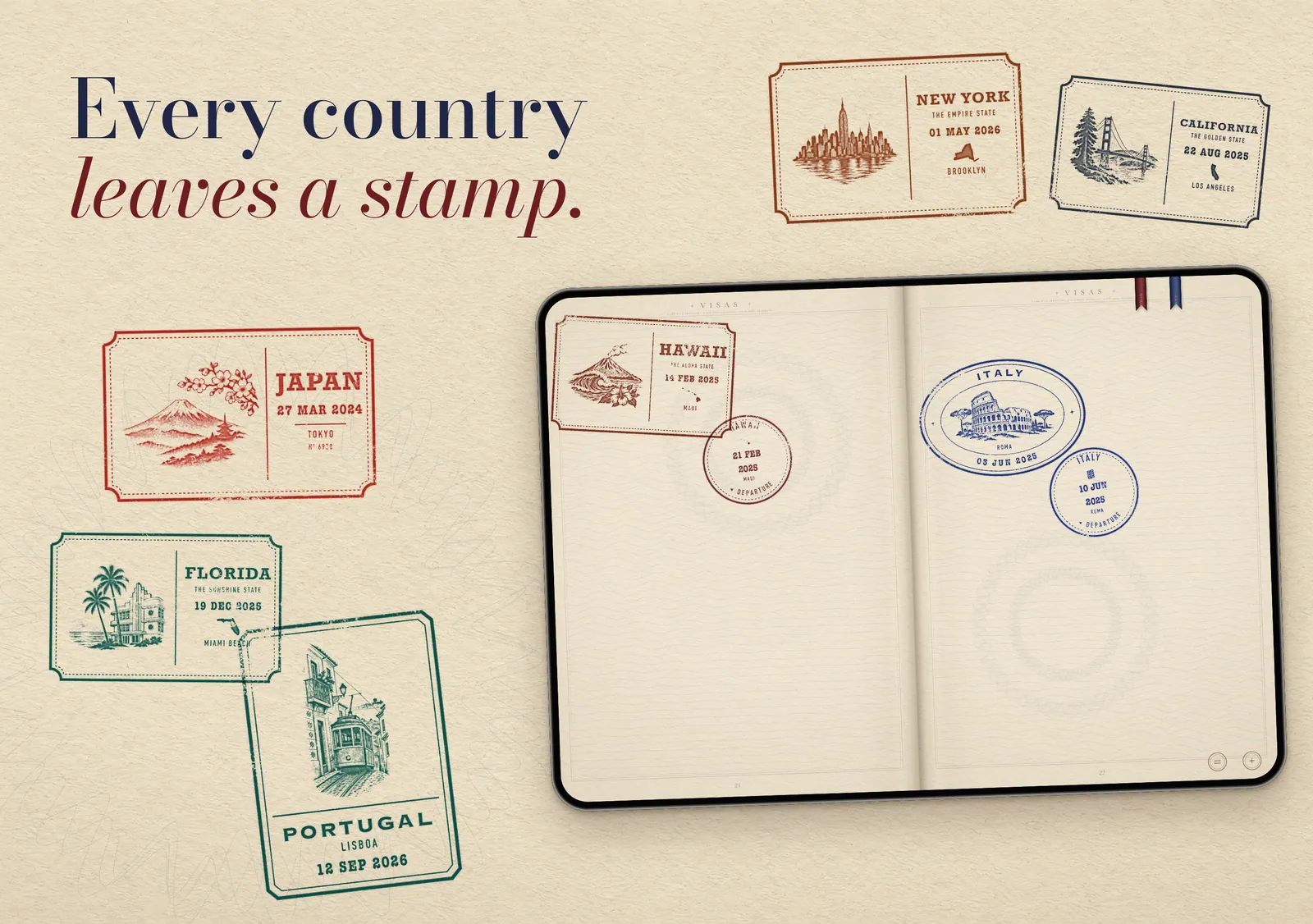
PASSPORT, an upcoming digital travel journal for iPhone, is designed around that connection between place and memory. It combines collectible country stamps and a visited-country map with dates, photos, personal notes and repeat visits. All fifty US states belong in the same passport, allowing a domestic journey its own place in the collection. Its essential travel-recording functionality is free.
The appeal is having a record you enjoy opening. But the habit works in any format: after a trip, add the place, check the date, keep a detail. Over time, the list becomes recognizable as your life.
Discover PASSPORT — collect the places, and keep something of the days you spent there.